You Won’t Believe What Lagos’ Streets Reveal at Golden Hour
Lagos doesn’t just wake up—it explodes into motion. From the first light over the Atlantic to the last glow above bustling markets, the city’s rhythm is written in sunlight and shadows. I came for the beaches but stayed for the viewing experience—the way colors shift on colonial facades, how motorbikes weave like fireflies at dusk. This isn’t just sightseeing; it’s sensory immersion. If you’ve ever doubted West Africa’s visual soul, Lagos will rewrite your eyes.
The Pulse of a Megacity: Understanding Lagos’ Visual Rhythm
Lagos is not a city that reveals itself all at once. It unfolds in layers—layers of sound, movement, and shifting light that together compose a visual symphony unlike any other. As Africa’s largest city by population, Lagos pulses with an energy that is both chaotic and harmonious. The visual rhythm of the city emerges not in stillness, but in constant motion: the swaying of danfo buses as they navigate potholes, the flicker of neon signs against dusk, and the sudden stillness of a roadside tailor stitching fabric under a fading sun. This rhythm is best understood not from a guidebook, but from standing still amidst the flow, allowing the city to move around you.
The contrast between old and new Lagos is one of the most compelling visual narratives. On one side, Eko Atlantic rises like a futuristic dream—a reclaimed land development with sleek high-rises, wide boulevards, and glass facades reflecting the ocean’s ever-changing blues. Across the lagoon, Victoria Island presents a different kind of modernity, where colonial-era buildings in faded pastels stand shoulder to shoulder with contemporary office towers. These older structures, with their wrought-iron balconies and shuttered windows, bear the patina of time, yet remain vibrant through adaptation—now housing boutiques, cafes, and art galleries. The juxtaposition tells a story of resilience and reinvention.
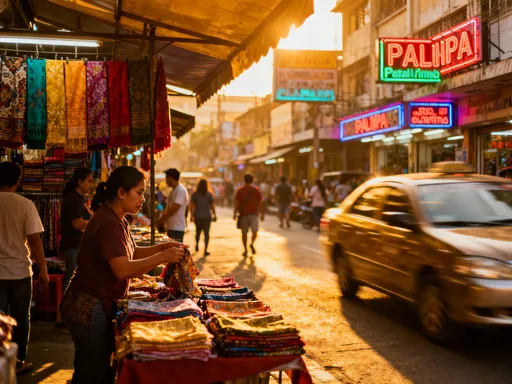
But it is during golden hour—the soft, slanted light that bathes the city in amber approximately an hour after sunrise and before sunset—that Lagos truly transforms. The harsh glare of midday gives way to a gentler illumination, softening edges and deepening hues. Shadows stretch long across sidewalks, and the metallic roofs of kiosks catch the sun like scattered coins. This is the moment when ordinary scenes become cinematic: a woman balancing a tray of plantains on her head becomes a silhouette against the horizon; a fisherman mending his net is framed in gold. Timing, therefore, is not just practical—it is essential to the viewing experience.
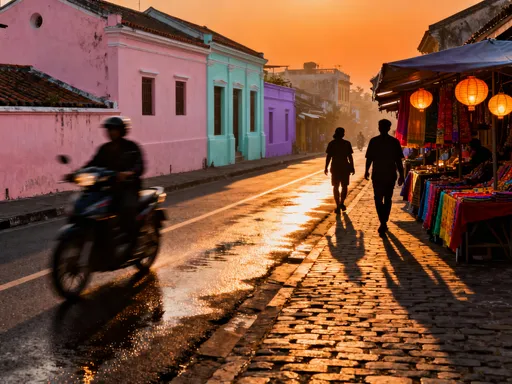
Real-time observations reveal how deeply intertwined daily life is with this rhythm of light. By late afternoon, street vendors begin to pack their wares under colorful umbrellas, their stalls glowing in the low sun. Traffic, often gridlocked, takes on a different character—less frustrating, more fluid, as headlights flicker to life and motorbikes dart like embers through the dusk. Even the sound changes: the honking of horns blends with the call to prayer and the distant hum of generators, creating a soundtrack that feels both urgent and meditative. To witness Lagos at golden hour is to understand that beauty here is not separate from life—it is woven into its very fabric.
Eyes on the Water: Coastal Vistas That Define Lagos
The soul of Lagos is undeniably tied to water. Cradled between the Atlantic Ocean and a network of lagoons, creeks, and mangroves, the city’s identity is shaped by its relationship with the sea. Nowhere is this more evident than along its coastal edges, where the interplay of light, water, and human activity creates some of the most breathtaking vistas in West Africa. At sunrise, the Lekki Peninsula shoreline glows in soft pinks and oranges, the calm surface of the lagoon mirroring the sky like liquid glass. By sunset, the same waters ignite in fiery reflections, turning boat silhouettes into dramatic cutouts against a molten horizon.
Admiralty Road in Lekki offers one of the most accessible and consistently stunning overlooks. From its wide sidewalks and elevated roundabouts, visitors can gaze across the lagoon toward Victoria Island, where skyscrapers shimmer in the distance. The view is especially powerful at golden hour, when the low sun casts long ripples across the water and local canoes glide silently, returning from a day’s fishing. Unlike many coastal cities where access is privatized, Lagos still offers public vantage points where anyone can pause and take in the scene—no admission, no gate, just open sky and water.
Further east, the Ibeju-Lekki mangroves present a quieter, more contemplative coastal experience. These dense wetlands, home to a rich ecosystem of birds, crabs, and fish, are best explored by boat. As the sun dips below the tree line, the mangrove roots glow in amber light, and the air fills with the soft chirping of kingfishers and the gentle lap of water against wooden hulls. This is not a postcard-perfect beach, but a living landscape—raw, resilient, and deeply beautiful in its natural complexity. Travelers who seek sustainable viewing opportunities will find here a model of low-impact engagement: small local operators offer guided tours that respect the environment and support community livelihoods.
Respect for local fishing communities is paramount when enjoying these coastal views. Many of the boats seen at dusk belong to families who have fished these waters for generations. Their presence is not part of a tourist spectacle but a continuation of daily life. Observing them requires a quiet presence—no loud noises, no intrusive photography, no littering. Sustainable tourism in Lagos means recognizing that these vistas are not just for looking at, but for sharing space with those who live within them. When travelers approach with humility and awareness, the reward is not just a beautiful image, but a deeper connection to the rhythm of coastal life.
Above the Noise: Rooftop and Elevated Perspectives
To truly grasp the scale and complexity of Lagos, one must rise above it. From the ground, the city can feel overwhelming—its density, its noise, its relentless motion. But from an elevated vantage point, chaos begins to reveal patterns. Rooftops, terraces, and high-floor lounges offer a different kind of viewing experience: one of clarity, perspective, and quiet awe. While not all buildings are open to the public, several hotels and commercial spaces in Victoria Island and Ikoyi provide legal and safe access to panoramic views, especially during early evening hours when golden light meets twilight.
The terrace of a mid-rise hotel in Ikoyi, for instance, offers a sweeping vista of the Third Mainland Bridge—one of the longest in Africa—stretching across the lagoon like a silver ribbon. As the sun sets, the bridge’s lights flicker on, and the water beneath reflects a constellation of moving headlights. From this height, the honking of traffic becomes a distant hum, and the weaving paths of motorbikes transform into rhythmic flows, like schools of fish navigating a current. What seems chaotic from the street becomes, from above, a testament to order within complexity.
Height also reveals the city’s intimate relationship with water. Lagos is built on islands, peninsulas, and reclaimed land, and from above, this geography becomes unmistakable. Lagoons curve around neighborhoods like natural moats, and narrow creeks cut through dense clusters of homes, some built on stilts. The contrast between land and water is especially vivid after rain, when the air clears and visibility sharpens. On such evenings, the city glows with renewed clarity—rooftops glisten, and distant hills emerge from the haze, offering a rare glimpse of Lagos’ topography beyond the urban sprawl.
For the best experience, timing is crucial. Early evening, shortly after golden hour, is ideal. The sky still holds the soft colors of sunset, while artificial lights begin to illuminate the city in warm gradients. Air quality, often affected by humidity and pollution, tends to improve after afternoon rains, making visibility sharper. Travelers should also consider visiting during the dry season (November to March), when cloud cover is minimal and the atmosphere is less hazy. These elevated moments are not just about photography—they are about reorienting one’s perception, learning to see Lagos not as noise, but as a living, breathing organism with its own logic and beauty.
Through Local Eyes: Community-Based Viewing Experiences
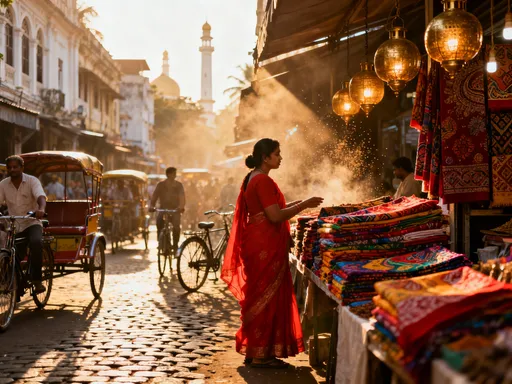
While postcard views have their place, the most meaningful visual experiences in Lagos often come not from observation, but from participation. Guided walks in neighborhoods like Maroko and Bariga offer a chance to see the city through the eyes of its residents—people who know its rhythms, colors, and textures in ways no tourist ever could. These districts, often overlooked by mainstream tourism, are rich with visual storytelling: murals painted on concrete walls, market stalls arranged like kaleidoscopes of fabric and produce, and laundry strung between buildings like vibrant banners in the wind.
Local guides do more than point out sights—they interpret them. A pile of colorful plastic chairs, to an outsider, might seem like clutter. To a resident, it’s a symbol of community life, used for weddings, funerals, and neighborhood gatherings. A wall covered in graffiti isn’t vandalism; it’s a canvas for social commentary, often reflecting hopes, struggles, and humor. These narratives transform passive viewing into active understanding, allowing visitors to appreciate not just what they see, but why it matters.
One of the most powerful aspects of community-based viewing is the emphasis on permission and reciprocity. In Maroko, for example, photographers are often asked to speak with shop owners or residents before taking pictures. This isn’t a barrier—it’s an invitation to connect. When travelers take the time to ask, to smile, to share a moment of conversation, the images they capture carry more weight. They become records of relationship, not just observation. This approach fosters cultural respect and ensures that tourism does not become extraction, but exchange.
Navigating these spaces requires sensitivity. Visitors should dress modestly, avoid loud behavior, and follow the lead of their guides. It’s also important to recognize that not every corner is meant for outsiders to explore. Some areas are private, others are simply not safe for unaccompanied visitors. But within these boundaries, there is still immense beauty to be found—beauty that reveals itself slowly, through patience and presence. The reward is not just better photographs, but a deeper sense of connection to the people who call Lagos home.
Chasing Light: The Photographer’s Lagos
For photographers, Lagos is both a challenge and a revelation. The city’s intense sunlight, high contrast, and fast-moving subjects make it difficult to capture with technical precision. Yet, it is precisely these challenges that make Lagos so rewarding to document. The key lies not in perfect exposure, but in embracing the city’s energy—its blur, its grain, its unpredictability. Golden hour remains the golden rule, offering the most forgiving light for both amateur and professional photographers. During this window, shadows are soft, highlights are controlled, and colors are rich without being oversaturated.
Angles matter as much as timing. Rather than shooting straight-on, photographers are encouraged to experiment with elevation and framing. A low-angle shot of a motorbike rider against the sunset can turn an everyday commute into a heroic silhouette. Shooting through window grilles or between market stalls adds layers of depth and context. Reflections—on puddles, car windows, or polished metal—offer creative opportunities to double the visual impact of a scene. Even the texture of walls, painted in peeling blues and yellows, can become a compelling subject when lit just right.
Equipment choices should prioritize discretion and mobility. Mirrorless cameras and compact zoom lenses allow for quick, unobtrusive shooting, minimizing disruption in crowded spaces. Tripods are rarely practical in Lagos’ dynamic environments, so mastering handheld stability is essential. Filters, particularly polarizers, can help manage glare on water and glass, while neutral density filters allow for longer exposures during daylight—useful for capturing the motion of traffic or flowing fabric in markets.
Equally important is the ethics of photography. Lagos is not a backdrop; it is a living city full of people with dignity and privacy. Photographers should avoid candid shots of individuals in vulnerable situations—such as street vendors asleep at their stalls or children in distress. When in doubt, ask. A simple gesture, a smile, a nod can turn a potentially exploitative image into a shared moment. The goal is not to capture the “exotic” or the “poor,” but to honor the resilience, creativity, and beauty of everyday life. In doing so, photographers contribute not just to their portfolios, but to a more respectful visual narrative of Lagos.
Beyond the Postcard: Hidden Visual Gems Off the Main Path
While Victoria Island and Lekki dominate tourist itineraries, some of Lagos’ most striking visual moments lie beyond the well-trodden path. These hidden gems are not necessarily secret—they are simply overlooked by those who stick to the obvious routes. Abandoned colonial-era buildings in Apapa and Lagos Island, for instance, offer a haunting yet beautiful study in decay and adaptation. Peeling paint, broken shutters, and overgrown courtyards tell stories of time and transformation. The play of light through empty windows and crumbling arches creates natural frames, turning ruins into art installations shaped by nature and neglect.
Quiet creek passages in areas like Makoko and Epe provide another kind of hidden beauty. Accessible only by canoe, these waterways wind through clusters of stilt houses, where daily life unfolds in intimate detail. Women wash clothes on wooden platforms, children leap into the water, and fishermen mend nets under thatched roofs. The light here is diffused—filtered through overhanging trees—creating a soft, dappled effect that feels worlds away from the city’s main roads. These scenes are not staged; they are lived. Travelers should approach with respect, using local boat operators and avoiding intrusive behavior.
The aesthetic of repurposed materials is another underappreciated visual theme. Across Lagos, creativity thrives in constraint. Corrugated metal sheets, painted in bright blues, greens, and reds, serve as walls, roofs, and market stalls. Wooden shutters, once functional, are now hand-painted with floral patterns or business names. Even drainage systems are transformed—some covered with mosaic tiles or decorated with bottle caps, turning infrastructure into folk art. These details may go unnoticed at first, but they reveal a city that improvises with beauty, turning necessity into expression.
Exploring these areas requires caution. Trespassing on private or unstable properties is dangerous and disrespectful. Instead, travelers should seek guided access, use local transport, and stay within safe, legal boundaries. Combining short trips—such as a boat ride from Ibeju to Epe or a walk through a community market—can yield unique perspectives without overstepping. The goal is not to “discover” Lagos, but to deepen one’s understanding of it, one quiet moment at a time.
Why Lagos Changes How You See Cities
To spend time in Lagos, especially during golden hour, is to have your perception of urban life reshaped. This is not a city of polished facades or manicured parks. It is a city of density, improvisation, and relentless creativity. What might initially appear as chaos reveals itself, upon closer look, as a complex system of adaptation—where every space is used, every object repurposed, every moment alive with purpose. The visual culture of Lagos teaches us that beauty does not require perfection; it thrives in resilience, in movement, in the ordinary made extraordinary by light and time.
Travelers often come to cities like Lagos seeking the “authentic,” but authenticity is not a static thing. In Lagos, it is dynamic—it lives in the way a street vendor arranges her peppers in a rainbow gradient, in the way a mechanic turns a roadside patch into a workshop, in the way children play football in a narrow alley as the sun sets. These moments are not staged for cameras; they are lived. To witness them is to move beyond filters, beyond hashtags, and beyond the desire to capture everything. Instead, it is to embrace the act of seeing—not as consumption, but as connection.
Lagos invites a different kind of engagement: one that values feeling over footage, presence over possession. It challenges the notion that great urban views must be grand or distant. Sometimes, the most powerful sight is a woman walking home with a bundle on her head, lit from behind by the last rays of sun. Sometimes, it is the way laughter echoes through a courtyard as families gather for evening meals. These are not postcard images, but they are the heart of the city.
In the end, Lagos does not just show you its streets—it changes how you see all cities. It teaches that urban beauty is not in order, but in life; not in silence, but in rhythm. For the mindful traveler, this is the greatest gift: not a photograph, but a shift in vision. So come to Lagos not to look, but to witness. Let the golden hour remind you that even in the busiest places, there is grace. And let the city, in all its vibrant, messy glory, rewrite your eyes.